
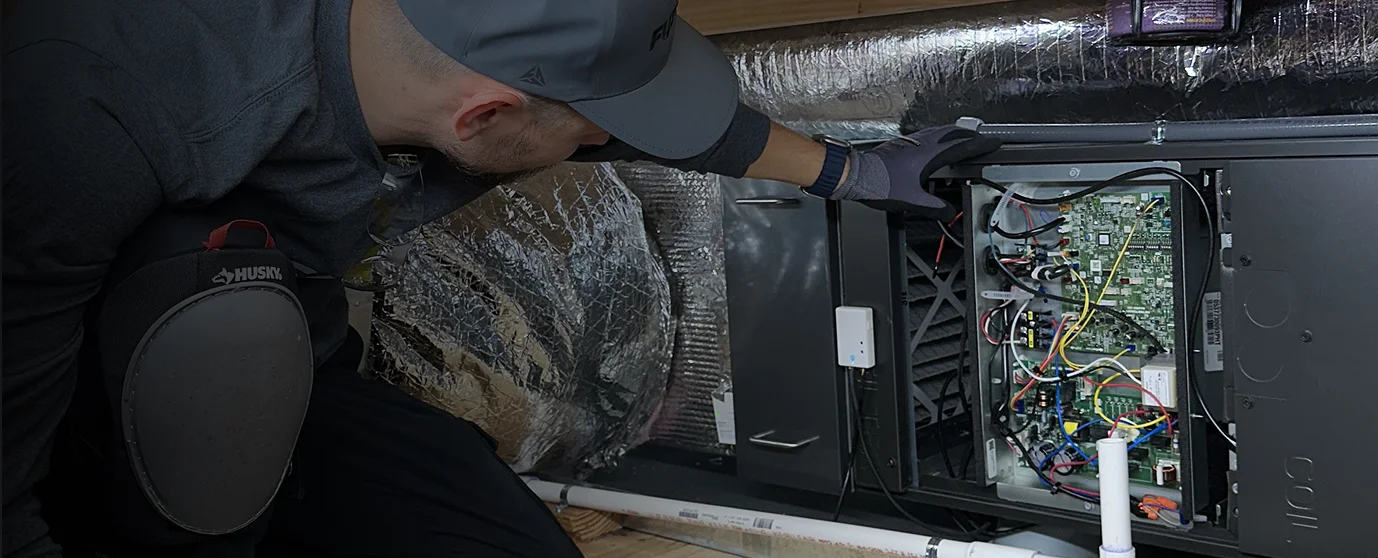




When a furnace quits, it rarely picks a convenient time — the house goes cold overnight, the thermostat clicks, and nothing happens at the vents. Most no-heat calls come down to a specific failed part, and most of those parts are already on our trucks. Our tech diagnoses the system, explains what failed in plain language, and quotes a fixed price before any work starts. Same-day furnace repair dispatch is available across King and Snohomish County for most calls.
Symptoms — When Your Furnace Needs Repair
No heat at all
The thermostat calls for heat and nothing responds — no burner, no blower. Common causes: failed hot surface igniter, bad control board, tripped safety switch, or a gas supply problem. Most of these are single-part furnace repairs we finish in one visit.
Loud bangs, rattles, or screeching
A bang at startup usually means delayed ignition — gas builds up before it lights. Screeching points to blower motor bearings or a failing inducer motor. Rattling panels are harmless; rattling from inside the cabinet isn’t.
Blower runs but the air is cold
Air moves but never warms. Usually an ignition problem: the burners don’t light, or they light and drop out because a dirty flame sensor can’t confirm the flame. The blower keeps running with no heat behind it.
Short cycling
The furnace fires, runs a few minutes, and shuts down — over and over. Common causes: dirty filter overheating the heat exchanger, a failing limit switch, or an oversized furnace. Short cycling wears parts fast; book a furnace repair before it takes another component with it.
Furnace starts, then shuts down
Burners light for a few seconds, then drop out. The usual culprit is a flame sensor coated in oxide — a quick clean or replacement. Less often it’s the pressure switch or a blocked flue.
Error code blinking on the control board
Most furnaces flash a diagnostic code — count the flashes and note the pattern before you call. The code narrows the diagnosis and helps us arrive with the right part on the truck.
Yellow or flickering burner flame
Burner flames should be steady and blue. Yellow or wavering flames mean incomplete combustion — dirty burners, a venting problem, or in the worst case a cracked heat exchanger. Shut the system off and have it inspected; this is the one symptom with a carbon monoxide risk attached.
Weak airflow at the registers
Usually an airflow problem, not a burner problem: clogged filter, failing blower motor, or a duct issue. A furnace starved for airflow also overheats and short cycles, so one cheap fix often clears two symptoms.
Gas bills climbing with no usage change
A furnace losing efficiency — dirty burners, a weak blower, constant short cycling — burns more gas to deliver the same heat. If the bill creep lines up with the furnace’s age, it may be telling you something bigger.
Thermostat clicks but nothing happens
The problem can be as small as a blown fuse on the control board or a tripped float switch on the condensate drain. On every furnace repair we check the cheap stuff first.
Our Repair Process
1. You call or book online
We confirm same-day availability where the route allows. Tell the dispatcher what the furnace is doing — no heat, short cycling, error code pattern — and we’ll come prepared.
2. Tech arrives in a stocked truck
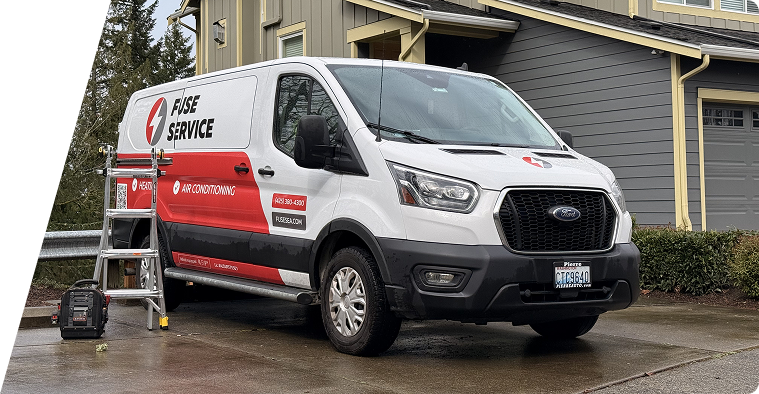
Standard inventory covers igniters, flame sensors, capacitors, limit switches, and common control boards. Most no-heat repairs finish without a parts run.
3. Full diagnostic
Your technician tests the ignition sequence, flame sensor, safety switches, controls, venting, and airflow to pinpoint the cause of the breakdown. We explain what failed and which repair is needed.
4. You get a fixed price before any work starts
After diagnosis, you receive a written quote for the recommended repair, including parts and labor. You approve the scope and price before repairs begin; any additional work requires your approval.
5. Repair completed on the same visit when possible
Once you approve the quote, we repair or replace the faulty component and make the necessary adjustments. If the part is available on the truck, we complete the repair during the visit; special-order parts require a scheduled return.
6. End-to-end system test and walkthrough
We run the furnace through full heating cycles, verify temperature rise and safe operation, then walk you through what failed and what we did.
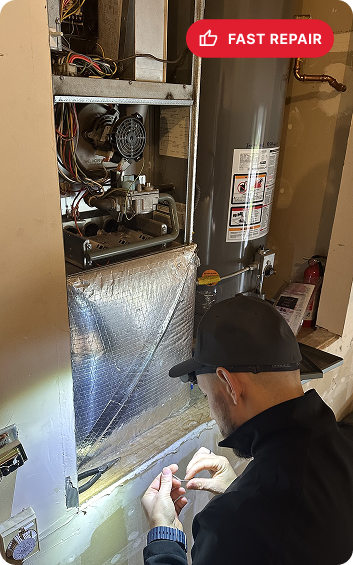
Why Choose Fuse Service for Furnace Repair
Same-day repair on most calls
Same-day repair on most calls across King and Snohomish County.
Licensed, Certified Technicians
Every tech is licensed in Washington State and trained on gas appliance safety and combustion diagnostics.
Upfront Pricing — No Surprises
You get a written quote after diagnosis, before we touch anything. The price we quote is the price you pay.
Parts & Labor Warranty
All repairs come with a warranty on parts and labor. If the same issue comes back, we come back.
What Affects Furnace Repair Cost
The failed component
Igniters, flame sensors, and switches are inexpensive parts and quick labor. Blower motors, inducer motors, and control boards cost more; a failing heat exchanger changes the conversation to replacement.
Equipment type
Single-stage furnaces use simple, widely available parts. Variable-speed and modulating furnaces have pricier boards and motors, and furnace repair takes longer to diagnose.
System age and parts availability
Parts for newer furnaces (under 10 years) are usually in stock with local distributors. Older or discontinued models can mean special-order parts and a second visit.
Brand
Brands with strong Seattle-area distributor networks (Trane, Lennox, Carrier) mean faster parts and lower cost. Less common brands can take longer to source.
Accessibility
A furnace in a garage or utility room is quick to work on. Tight attic installs and crawl-space units add labor time.
Replace or Repair Your Furnace?
Gas furnaces usually last 15–20 years with regular service. If yours is still inside that window and the failure is a single part, repair is usually the right call. Past year 15 — or with a cracked heat exchanger — the math flips toward furnace replacement. Here’s the framework we use on-site.
| Repair makes sense if: | Replacement makes sense if: |
|---|---|
| Furnace is under 10 years old | Furnace is over 15 years old |
| It’s a single failed part (igniter, flame sensor, capacitor, blower motor) | You’ve had 2+ repairs in the last two years |
| The heat exchanger is intact | The heat exchanger is cracked — a carbon monoxide risk, not a repair |
| Repair cost is under 30% of replacement cost | Gas bills keep climbing year over year |
| Annual maintenance has been done | Rooms heat unevenly even after repairs |
| It’s an 80% AFUE unit and you’re weighing an upgrade to a 95%+ model or a heat pump | |
Furnace Brands We Repair
We repair the major furnace brands installed across Seattle and the Eastside: Trane, Lennox, Carrier, Bryant, Rheem, Goodman, American Standard. Our trucks carry the most common igniters, sensors, and boards.





Areas We Serve
Fuse Service repairs furnaces across King and Snohomish County. Our techs know the equipment installed in local housing stock — and the venting quirks that come with older Puget Sound homes.
Related Furnace Services
Furnace repair is one piece of keeping a heating system healthy. Related services we handle across King and Snohomish County: