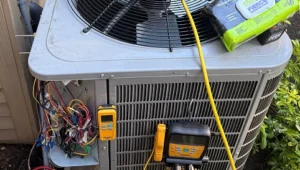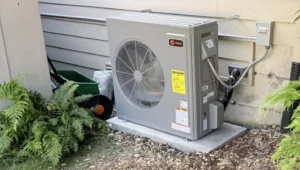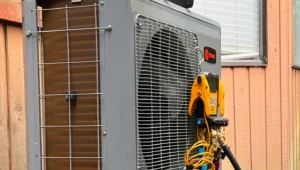
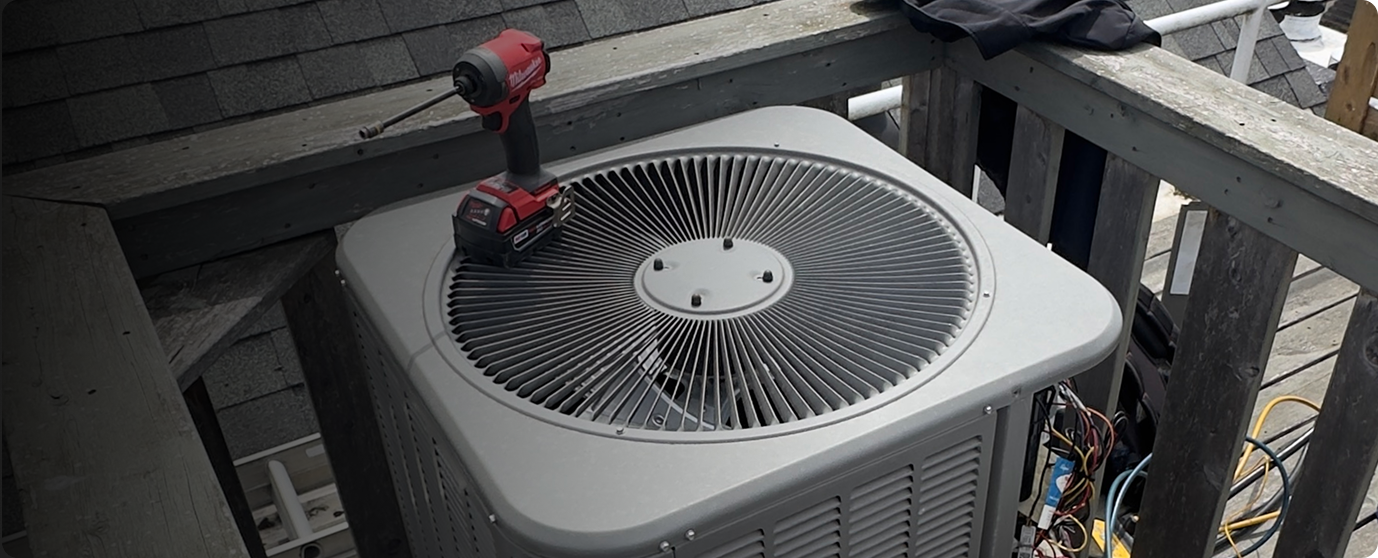




When a heat pump quits, it’s usually obvious — the house gets cold in January or hot in July and the system isn’t responding. Sometimes it’s louder than usual, sometimes there’s ice on the outdoor unit, sometimes the thermostat throws an error code. Knowing when you need heat pump repair can be crucial to getting your system working again. The job is to find out which component is the actual problem and fix it without replacing parts that don’t need replacing.
Symptoms — When Your Heat Pump Needs Repair
Not heating in winter
The outdoor unit may be running but the indoor air handler is blowing cold air. Common causes we find on a heat pump repair call: reversing valve stuck in cooling mode, low refrigerant, defrost board fault, or a failed compressor.
Loud or unusual noises
Grinding, screeching, or banging from the outdoor unit usually points to bearing wear, a failing fan motor, or a compressor issue. Rattling is often a loose panel or debris in the fan — cheap fixes. We diagnose to tell the difference.
Not cooling in summer
Opposite problem, same kinds of root causes — reversing valve, refrigerant level, contactor, or compressor. Capacitors are also a common single-component failure that knocks out cooling.
Short cycling
System turns on, runs for a minute or two, then shuts off and repeats. Common causes: oversized system, dirty filter, low refrigerant, failing pressure switch, or thermostat placement issue.
Blowing room-temperature air
The blower is moving air but the refrigerant cycle isn’t producing the temperature change it should. Usually points to a refrigerant leak, a failed compressor, or a reversing valve problem.
Error codes on the thermostat or indoor unit
Most modern systems display a code when something fails. The code narrows the diagnosis significantly — mention it when you book your heat pump repair.
Ice on the outdoor unit in winter
A thin layer of frost is normal in cold weather — the defrost cycle clears it every couple of hours. A solid block of ice means the defrost cycle isn’t running, which usually means a bad defrost board, defrost sensor, or reversing valve.
Weak airflow at the registers
Usually an indoor problem: clogged filter, dirty evaporator coil, failing blower motor, or duct issue. Sometimes it’s a frozen indoor coil — turn the system off and call before continuing to run it.
High electric bills with no usage change
A heat pump that’s losing efficiency (failing compressor, low refrigerant, dirty coils, broken aux heat stuck on) burns more power for the same comfort.
Frozen indoor coil
If the indoor coil is iced over, the system needs to be shut off and allowed to thaw before diagnostics. Running it frozen damages the compressor and turns a small heat pump repair into a major one.
Our Heat Pump Repair Process
- You call or book online
We confirm same-day availability where the route allows. Tell the dispatcher what the system is doing — error codes, ice, noises, anything — so the tech arrives with the likely parts. - Tech arrives in a stocked truck
Standard inventory covers capacitors, contactors, sensors, defrost boards, and common refrigerant configurations. Most heat pump repairs don’t need a second visit. - Full diagnostic
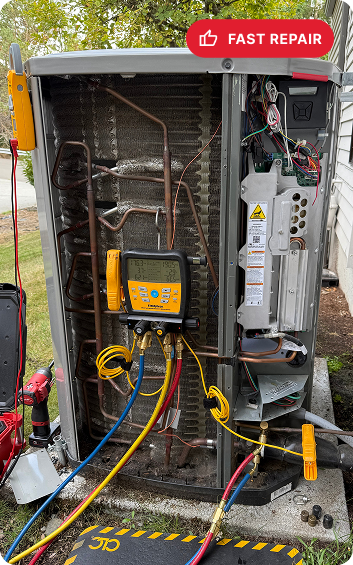
We test refrigerant pressures, electrical components, controls, and airflow. The goal is to confirm the actual failed part, not guess based on symptoms. - You get a fixed price before any work starts
No “ballpark” pricing, no surprise add-ons. If the repair turns out more involved than expected mid-job, work pauses until you approve. - Repair completed on the same visit when possible
Common parts are on the truck, so most fixes are finished on the first visit. If an older or discontinued model needs a special-order part, that usually adds 1 to 3 business days, and we book the return visit once the part arrives. - End-to-end system test and walkthrough
We verify the system runs through both heating and cooling cycles, then walk you through what failed and what was done.
Why Choose Fuse Service for Heat Pump Repair
Same-day repair on most calls
Same-day repair on most calls across King and Snohomish County.
Licensed, Certified Technicians
Every tech is licensed in Washington State and EPA Section 608 certified to handle refrigerants legally and safely
Upfront Pricing — No Surprises
You get a written quote after diagnosis, before we touch anything. The price we quote is the price you pay.
Parts & Labor Warranty
All repairs come with a warranty on parts and labor. If the same issue comes back, we come back.
What Affects Heat Pump Repair Cost
The failed component
Capacitors, contactors, and sensors are inexpensive parts and quick labor. Compressors, reversing valves, and ECM blower motors are expensive parts and longer labor. The diagnostic tells you which category your heat pump repair falls into.
Refrigerant type
Systems on R-22 (pre-2010) cost more to recharge because R-22 is no longer produced and existing stock is expensive. R-410A and R-454B are still produced and priced normally.
System age and parts availability
Parts for newer systems (under 10 years) are usually in stock with manufacturer distributors. Older or discontinued models sometimes require a special-order part, which adds 1 to 3 business days.
Brand
Some manufacturers (Mitsubishi Electric, Trane) have strong distributor networks in the Seattle area and same-day part access. Others occasionally require longer lead times.
Accessibility
Standard ground-level outdoor units are quick. Rooftop installs, tight crawl-space air handlers, or attic-mounted indoor units add labor.
Repair or Replace Your Heat Pump?
Heat pumps usually last 15-20 years with regular service. Somewhere around year 10-12, every repair becomes a math problem: fix this one, or put the money toward a new system that’ll run another 15 years and cut your electric bill. Here’s how we think about it on the call.
| Repair makes sense if: | Replacement makes sense if: |
|---|---|
| System is under 10 years old | System is over 12–15 years old |
| It’s a single failed component (capacitor, contactor, sensor, defrost board) | You’ve had 2+ repairs in the last two years |
| Refrigerant is the original type (R-410A or R-454B) | The compressor failed, or it uses R-22 refrigerant |
| Repair cost is under 30% of replacement cost | The system can’t hold temperature on cold mornings, even when working |
| Annual maintenance has been done | You’re seeing electric bills creep up year over year |
| You want better efficiency and cold-weather performance |
Brands We Service
We repair the major heat pump brands installed across Seattle and the Eastside: Mitsubishi Electric, Bosch, Trane, Carrier, Lennox, Goodman, RunTru. We have distributor relationships that get OEM parts fast.





Heat Pump Repair Service Areas
Fuse Service repairs heat pumps across King and Snohomish County. Our techs know the equipment that’s installed in each area — the wave of Eastside installs from the late 2000s, the newer cold-climate units going in around Seattle, the older Mitsubishi mini-splits in Capitol Hill and Ballard.