 by
by 
If your furnace is pushing 15 years and your summers now end with a box fan in the window, you are already in the market for a heat pump — you just may not know it yet. A heat pump replaces two pieces of equipment with one, heats and cools the whole house, and does it on a fraction of the energy a traditional system needs. Here are the five benefits homeowners notice first.
Energy Savings
A furnace makes heat. A heat pump moves it — and moving heat is far cheaper than creating it. For every unit of electricity it draws, a modern heat pump delivers roughly three to four units of heating, which puts real-world efficiency in the 300–400% range. A high-end gas furnace tops out around 95%. Electric baseboards and wall heaters sit at 100% and never go higher.
That gap is where the savings live. Homes coming off electric resistance heat see the sharpest drop, often cutting the heating portion of the bill close to half. Homes coming off an aging gas furnace see a smaller but steadier reduction, especially once the old system’s real efficiency — not its sticker rating — is factored in.
Our climate helps. Western Washington winters hover in the range where heat pumps are at their most efficient, so the system rarely needs to lean on backup heat the way it would in Minnesota. And because inverter-driven compressors modulate instead of slamming on and off at full power, the unit spends most of its life running at 30–40% capacity, sipping energy rather than gulping it.
Add utility rebates and federal efficiency tax credits, and the payback window shortens considerably. We will tell you exactly which incentives your address qualifies for before you commit to anything.
Improved Comfort
Efficiency numbers are easy to argue about. Comfort is the part homeowners actually feel on day one.
A conventional furnace works in bursts: it blasts 120-degree air until the thermostat is satisfied, shuts off, and lets the house drift until it is cold enough to start over. You feel that cycle as hot spots, cold spots, and drafts. A variable-speed heat pump does the opposite — it runs long and low, delivering gentle, continuous air that holds the house within about a degree of your setpoint. No temperature swings, no rooms that are always ten degrees off from the rest of the house.
In summer, the same slow, steady operation does something an oversized AC cannot: it pulls humidity out of the air. Longer run times mean more moisture removed, which is why a properly sized heat pump feels cooler at 74 degrees than a cycling system feels at 71.
For homes with rooms that have never been comfortable — a converted attic, a bonus room over the garage, an addition the ductwork never reached — a ductless mini split solves the problem without tearing into walls. Each zone gets its own thermostat, so the office can sit at 68 while the bedroom stays at 72. (внутренняя ссылка на пост про mini split installations)
Environmental Impact
A heat pump burns nothing. There is no combustion in your home, which means no on-site carbon emissions, no combustion byproducts, and no carbon monoxide risk from your heating system at all.
The footprint math is especially favorable here. Washington’s grid runs largely on hydro and other non-fossil sources, so the electricity powering your heat pump starts out far cleaner than the national average. Swapping a gas furnace for a heat pump in this region cuts household heating emissions dramatically — and unlike a furnace, which is locked to fossil fuel for its entire service life, a heat pump keeps getting cleaner as the grid does. The system you install today will be greener in ten years without you touching it.
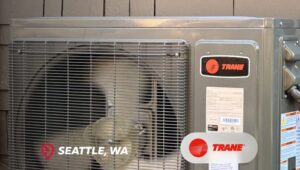
Current-generation equipment also uses low-GWP refrigerants like R-454B, a significant improvement over the refrigerants used in systems installed even a few years ago. Trane’s high-efficiency heat pump line pairs that with efficiency ratings that qualify for most rebate programs — which is why we recommend it for homeowners whose priority is cutting their footprint, not just their bill.
Increased Home Value
Buyers in this market read the HVAC section of an inspection report closely, and “new heat pump, installed 2026” reads very differently than “original furnace, age unknown.”
Two things drive the value. First, efficiency: energy-conscious buyers price operating costs into their offers, and a documented low-consumption system is a concrete advantage over the comparable listing down the street. Second — and this matters more every summer — a heat pump means the house has air conditioning. A large share of older Seattle-area homes still do not. After the last several heat waves, central cooling has moved from a nice-to-have to a line item buyers actively search for.
A new system also removes a negotiating lever. An aging furnace is something a buyer’s agent uses to push the price down or demand a credit at closing. A recent, professionally installed, warrantied system takes that conversation off the table.
Keep the paperwork. Model and serial numbers, SEER2 and HSPF2 ratings, permit records, and annual maintenance documentation turn a claim about efficiency into evidence — and give an appraiser something to work with.